
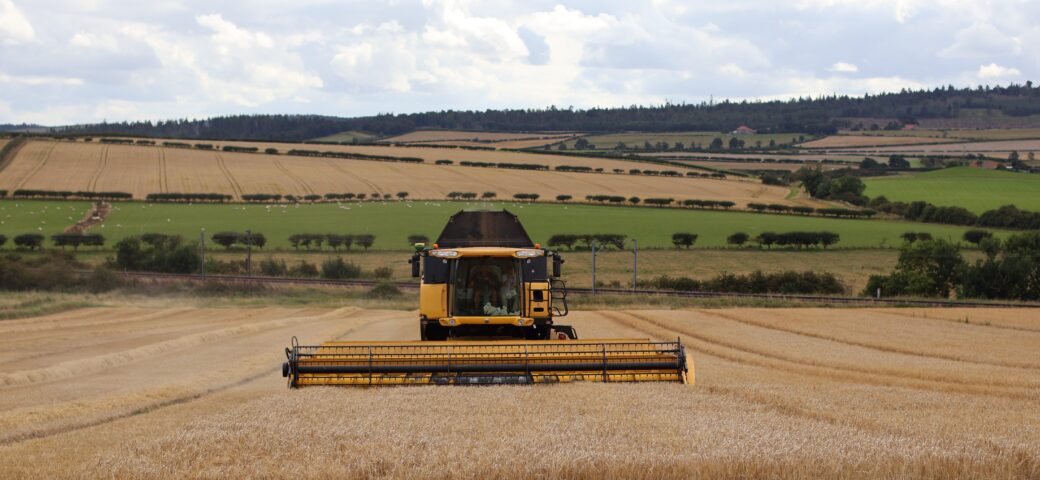
Each season seems to bring its own set of hurdles and 2025 has been no exception. While spring crops went into the ground in near perfect conditions, the wider picture has been far more challenging with DEFRA reporting that England faced its second worst harvest on record.
In this article, members of our in-house grain trading department – Rob Austin and Sarah Hynes – discuss the main factors that have shaped this year’s barley harvest across the UK.
They also highlight the importance of looking at global influences rather than solely what is being experienced in the UK and share a few reasons why there may still be room for cautious optimism moving forward.
An early forewarning…
In autumn 2024, it became clear through conversations with our distilling customers that the spring malting barley requirement for harvest 2025 would be lower than in previous years.
As a result, we took the difficult step of informing our contracted growers in autumn 2024 that demand was decreasing and that our spring malting barley requirements would be lower.
Although this was far from ideal, it allowed growers – who we deal with directly through our agricultural merchanting division McCreath Simpson & Prentice – to halt any further crop input purchasing and provide them with the opportunity to sow alternative crops in spring 2025.
Weather woes
After the forewarning about reduced demand, the UK was then hit with weather conditions that left their mark on the season’s crops.
Autumn 2024 was wetter than the 30-year average (1991-2020) but, by the time spring arrived, conditions had flipped with much of the east of the UK enduring a three-month drought.
Data from the Met Office shows that the UK recorded its sunniest spring on record based on the 30-year average, with 653.3 hours of sunshine. Rainfall totals, meanwhile, were significantly below average across the UK, making it the sixth driest on record.
For many growers who opted to drill spring crops, the early conditions were ideal as seedbeds were in good shape and this allowed for a good growth spurt for crops.
However, by early May, the effects of the prolonged lack of rainfall were becoming clear, with some spring barley struggling to emerge and many crops aborting tillers, leaving them with only primary shoots.
When the rain finally arrived in late May, it was very welcome, but for some crops it came too late.
2025 Barley Harvest – UK Winter Barley
The UK barley harvest got off to its earliest start in decades. In fact, one of our longest-serving colleagues believed it was the earliest barley intake we’ve had in his 40-year plus career. This was driven by the long, dry spell in the spring and early summer heatwave.
According to the AHDB, it is estimated that around 10% of winter barley in the UK had already been harvested by July 9, significantly ahead of the five-year average of 6%.
Despite the challenges of a very dry spring and early summer heat, this year’s winter barley harvest exceeded initial expectations with the crops performing well and delivering big, bold barley and lower nitrogen levels than anticipated.
On the whole, quality was generally good. However, yields tell a more mixed story. Reports on farm vary from 29% down to 19% above the five-year average but, overall, the UK winter barley yield is in line with the five-year average.
For the winter barley destined for the production of specialty malts in our Roast House, this was welcome news. Spring barley, however, presented us with a different set of challenges.
2025 Barley Harvest – UK Spring Barley
Unfortunately, the story for spring barley was less favourable this year.
The southern harvest kicked off first and progressed quickly, but quality proved mixed. A clear pattern emerged of high nitrogen levels, largely driven by the three-month spring drought and low ear population.
In parts of northern England, the Borders and Lothians, early results were more encouraging. Barley was cut at low moisture levels – frequently around and below 16-17% – and nitrogen levels were generally lower than those seen in the south. This not only reduced drying costs for growers but also allowed for earlier drilling of autumn crops when the ground conditions were good.
However, moving north of the Forth, the variability became increasingly site specific with well bodied soils holding onto moisture and producing initial good samples of barley, while lighter soils struggled and the quality gap widened. As the season progressed, grain size fell, retention issues increased and screenings rose. Although these quality problems were initially concentrated in the north, they filtered further south as harvest progressed.
Screenings – reaching up to 30% in some areas – have been one of the most notable challenges in this year’s spring barley harvest with levels consistently above what we would normally see. Much of the variability can be traced back to the season’s weather pattern.
Against this backdrop, our pre-delivery sampling process – enabled by our business model – proved extremely valuable this year as it allowed us to establish a picture of overall quality and plan intake accordingly before wagons arrived on site. We worked closely with growers on quality parameters where possible, ensuring that together we met the standards expected throughout the supply chain.
Cereal Market Overview
Demand for malting barley, particularly from the distilling sector in Scotland, has fallen over the past 12-18 months and has been driven by several factors, including turbulent global trading conditions, rising costs, high stock count and changing consumer behaviour.
Global markets are amplifying pressure on the UK position. A bumper US maize crop supply and further international competition has added another layer of difficulty.
Only a couple of years ago, tight supply from Scandinavia driven by a widespread drought supported strong malting premiums. However, this season, the region has had a strong harvest, reducing import demand and driving malting premiums lower.
Domestic barley quality is behind that of key competitors and with a large volume of malting barley failing to meet malting specification this year, it has been subsequently diverted to the feed market and the base price has been pushed down further.
The UK has slipped down the export queue and these market pressures and low premiums have already prompted many UK growers to reassess their cropping decisions for 2026, which will inevitably lead to a reduced malting barley area.
When will things turn around?
As is often the case in agricultural markets, when prices remain under pressure for an extended period, external factors do tend to have a way of turning this around or, as the old saying goes, ‘low prices cure low prices’.
The winter barley market is a good example of this where, over recent seasons, we’ve seen the planting area decrease in size. As a result, we have had to contract barley to ensure we have sufficient supply. It’s a clear reminder that prices rarely move in just one direction.
Meanwhile, the India trade deal negotiated earlier in the year has the potential to be important to the industry. It could provide lots of opportunities and influence global demand patterns for malt and, subsequently, barley.
This industry is inherently known for its cyclical nature, with price and supply cycles historically taking around three to five years to cement themselves. However, what we seem to be witnessing at the moment is a faster change, with shifts that we once saw unfold over several years now happening within a single year or so.
Conclusion
In summary, 2025 has been an incredibly challenging year shaped largely by the UK suffering a poorer quality harvest than other key producing regions and a significant reduction in end user demand.
Despite its challenges, the overall picture is not without its positives with the early harvesting allowing many growers to drill autumn crops early when seedbeds were in good condition.
While oversupply and strong global competition have put pressure on prices, market dynamics can shift quickly and as such, volatility is likely to remain a feature of the year ahead, but the industry’s adaptability and potential emerging opportunities offer hope for cautious optimism.